
INVERTER • STORAGE CONTROL • MONITORING

Solis inverter technology, engineered into a complete Moebotics Energy solution.
The inverter is where solar generation, battery operation, site loads and the grid meet. The Moebotics Energy technology stack brings usage, tariff, roof, supply, export settings, critical loads and operating priorities together to shape a high-performance Solis solution.
Moebotics Energy independently evaluates and specifies Solis equipment within a complete, site-specific energy solution.

Figures shown are reported by Solis Australasia . Product availability and specifications are confirmed for each proposal.
WHY THE INVERTER MATTERS
The control centre of a smarter energy system.
A well-selected inverter helps an array perform across different roof orientations, coordinates compatible storage, manages exports, supports resilient backup design and makes valuable operating data visible. Moebotics Energy aligns these functions with the exact model and complete system architecture.
Solar conversion
Purpose-designed MPPT and input configuration brings panel strings, roof orientations, shading conditions and current levels into one coordinated design.
Storage control
Hybrid and AC-coupled families coordinate manufacturer-compatible batteries through matched models, firmware and commissioned settings.
Export management
Compatible meters and controls help manage site exports within the selected connection and network settings.
Backup operation
Selected models enable backup or EPS functions through a coordinated battery, switchgear, critical-load and protection design.
Operating visibility
Supported loggers, meters and SolisCloud provide valuable system information for commissioning, review and ongoing optimisation.
HARDWARE AT A GLANCE
See the step from residential to commercial scale.
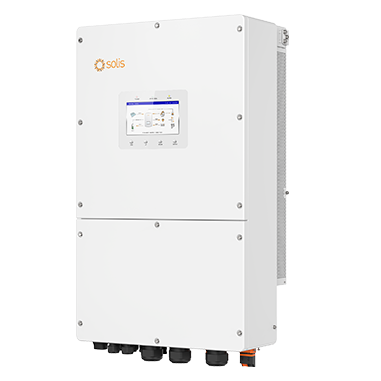
Compare the compact residential format with larger commercial hardware. We confirm the exact model, suffix and compatible battery pairing for the site.
RESIDENTIAL HYBRID FORMAT
Compact wall-mounted hardware
Designed for residential solar, battery and backup applications.
COMMERCIAL HYBRID FORMAT
Larger commercial hardware
Designed for higher-power business and commercial energy systems.
FEATURED AUSTRALIAN HYBRID FAMILIES
From home storage to larger commercial systems.
The official Australian catalogue currently carries S5, S6 and RHI products together. These examples demonstrate the breadth available for Moebotics Energy to match with residential, commercial and industrial energy priorities.
HOME • SINGLE PHASE • LOW VOLTAGE
S6-EH1P(3–8)K-L-PLUS-AU
3–8 kW family. Solis lists under-4 ms backup switching, generator interface, 200% PV input capacity and parallel expansion to a stated 48 kW.
Official model page
HOME / SMALL BUSINESS • THREE PHASE • LOW VOLTAGE
S6-EH3P(8–15)K02-NV-YD-L-AU
8–15 kW family. The manufacturer lists under-10 ms switching, generator support, six-unit parallel operation and IP66 enclosure protection.
Official model page
COMMERCIAL • THREE PHASE • HIGH VOLTAGE
S6-EH3P(29.9–50)K-H-AU
29.9–50 kW family with four MPPTs and two independently controlled battery ports. Solis lists six-unit parallel support and under-10 ms switching.
Official model page
LARGE C&I • THREE PHASE • HIGH VOLTAGE
S6-EH3P(80–125)K10-NV-YD-H-AU
80, 100 and 125 kW models. Solis lists ten MPPTs, two battery ports, up to 200 A charging and multi-unit architecture reaching a stated 1.25 MW.
Official model pageDesign insight: Solis uses “200% PV input” to describe published PV-side sizing headroom on specified products, while the selected inverter’s rated AC output defines its continuous conversion capacity.
HYBRID & STORAGE-INVERTER DIRECTORY
Current families shown by Solis Australia.
Use this directory to explore the breadth of the range. Moebotics Energy aligns exact suffixes, firmware, battery compatibility, certificate status and network settings during system design.
| Family | Architecture | Displayed output | Selected manufacturer-listed capability |
|---|---|---|---|
| S6-EH1P(3–6)K-L-AU ↗ | Single phase, low voltage | 3–6 kW | Up to 5 kW backup; under-10 ms switching; 125 A / 6 kW charging and discharging. |
| S5-EH1P(3–6)K-L ↗ | Single phase, low voltage | 3–6 kW | Up to 5 kW backup; lithium and lead-acid support listed; remote management. |
| S6-EA1P(3.6–6)K-L ↗ | Single phase, AC-coupled | 3.6–6 kW | Storage retrofit pathway; six time-of-use periods; remote battery monitoring. |
| S6-EH1P(3–8)K-L-PLUS-AU ↗ | Single phase, low voltage | 3–8 kW | Under-4 ms switching; generator interface; parallel expansion. |
| S6-EH1P(10–16)K03-NV-YD-L-AU ↗ | Single phase, low voltage | 10–16 kW | Three MPPTs; generator integration; smart-load management. |
| S6-EH3P(5–10)K-H-AU ↗ | Three phase, high voltage | 5–10 kW | Under-10 ms switching; AC coupling; three-phase unbalanced output. |
| RHI-3P(5–10)K-HVES-5G ↗ | Three phase, high voltage | 5–10 kW | Up to 10 kW continuous backup and 16 kVA stated peak; time-of-use modes. |
| S6-EH3P(8–15)K02-NV-YD-L-AU ↗ | Three phase, low voltage | 8–15 kW | Generator support; six-unit parallel operation; under-10 ms switching. |
| S6-EH3P(12–20)K-H-AU ↗ | Three phase, high voltage | 12–20 kW | Four MPPTs; generator and SG-Ready connectivity; parallel operation. |
| S6-EH3P(29.9–50)K-H-AU ↗ | Three phase, high voltage | 29.9–50 kW | Dual battery ports; four MPPTs; six-unit parallel support. |
| S6-EH3P(80–125)K10-NV-YD-H-AU ↗ | Three phase, high voltage | 80–125 kW | Ten MPPTs; dual battery ports; DC/AC coupling and genset integration listed. |
GRID-CONNECTED STRING INVERTERS
Solar-only families from 0.7 kW to 255 kW.
Solis lists residential, commercial and utility string families with different MPPT counts, input-current limits, monitoring and export-control options.
Single-phase range
- S5-GR1P(0.7–3)K-M — compact 0.7–3 kW family.
- S6-GR1P(3–6)K-S — two MPPTs, 16 A string current and IP66 listed.
- S5-GR1P(3–6)K — two MPPTs and meter-enabled 24-hour monitoring listed.
- S6-GR1P(5–10)K03-NV-ND-AU — three MPPTs for multi-facing roofs; 5–10 kW.
- S5-GR1P(7–10)K — three MPPTs; 7–10 kW.
Three-phase residential & C&I range
- S6-GR3P(5–10)K03-NV-ND-AU — residential three-phase, three MPPTs.
- S5-GR3P(5–20)K — residential and small C&I family.
- S5-GC(25–50)K-AU — four MPPT commercial range.
- S5-GC(50–70)K — five or six MPPTs.
- S5-GC80K — 80 kW with nine MPPTs.
- S5-GC(100–125)K-AU — ten MPPT C&I range.
- Solis-(215–255)K-EHV-5G — utility-scale string family.
STORAGE & OPERATING VISIBILITY
A connected ecosystem shaped around the site.
Moebotics Energy can integrate a Solis inverter with the most suitable manufacturer-compatible storage architecture. Solis batteries, controls and monitoring options broaden the pathways available for a coordinated solution.
IntelliHome
14 kWh and 16 kWh low-voltage home batteries. Solis lists up to eight units in parallel, wall or floor mounting and IP66/C5M protection.
EverCore
99.9, 100 and 120 kWh cabinet variants, including PRO models, with integrated power-conversion and energy-management functions described by Solis.
SolisCloud
Native manufacturer monitoring for supported devices, plus catalogue options for Wi-Fi, RF, 4G, wired and plant-level data logging.
Solis-EPM-5G
Export-power management and generation/load monitoring. Solis states one unit can control and monitor up to 20 compatible inverters.
Moebotics Energy configures the inverter, logger, meter, communications, firmware and data permissions as a coordinated operating layer—supporting timely insight, performance review and informed optimisation within the selected service program.
BACKUP AS A COMPLETE SYSTEM
Engineer rapid switching into a resilient energy design.
Published transition times become most valuable when paired with the right battery, available energy, inverter output, surge capacity, critical-load circuits, switchgear, protection and commissioning. Moebotics Energy brings these elements together around the site’s backup priorities.
Load prioritiesMap priority circuits and their operating, starting and surge requirements.
Battery matchSelect the exact battery model, BMS protocol, firmware and supported capacity.
Electrical architectureDesign EPS or backup circuits, switching, isolation and protection for the site.
Network alignmentAlign connection, export and phase settings with applicable distributor requirements.
Commissioning confidenceTest the designed operating modes and document final settings and responsibilities.
AUSTRALIAN SUPPORT & WARRANTY
Selected S6 inverter warranties extendable up to 20 years.
Solis Australasia provides Australian sales, after-sales and warranty support together with a service network of qualified and accredited technicians.
Selected current S6 hybrid inverters
Current official Australian manuals list manufacturer warranty coverage extendable to 20 years for selected S6 hybrid families.
Local service pathway
Australian sales, after-sales and warranty support provide a clear local pathway throughout the product lifecycle.
Clear warranty coverage
Moebotics Energy confirms the warranty term available for the exact selected model.
Manufacturer eligibility: the 20-year maximum is published for the S6-EH1P(10–16)K03-NV-YD-L-AU and S6-EH3P(80–125)K10-NV-YD-H-AU families where the eligible manufacturer warranty extension is selected. View the official residential S6 manual and large C&I S6 manual .
THE MOEBOTICS ENERGY TECHNOLOGY STACK
Begin with data. Finish with the right inverter architecture.
Our coordinated pathway transforms available customer-authorised data, scenario modelling and design inputs into confident hardware selection and informed lifecycle review.
- 01
Understand
Review available bills, interval data, tariffs, loads, roof, supply, existing assets and future plans.
- 02
Optimise
Compare suitable solar, storage, tariff and operational scenarios with visible assumptions.
- 03
Install
Select and document exact products, approvals, engineering, battery compatibility, installation and commissioning requirements.
- 04
Monitor
Use supported operating information within the selected service program to review performance against the designed intent.
- 05
Manage
Apply informed, authorised changes as loads, tariffs, firmware, network settings or priorities evolve.
SOLIS QUESTIONS
Design answers for a stronger result.
How does a Solis hybrid system support backup?
A compatible battery and a deliberately engineered EPS or backup architecture bring suitable circuits, loads, protection, switching and commissioning together. Moebotics Energy shapes the design around the customer’s priority loads and resilience goals.
How is battery compatibility selected?
Moebotics Energy matches the exact battery, BMS protocol, firmware, voltage, current and capacity with current manufacturer-supported compatibility information for the selected inverter.
How is an Australia-ready Solis model selected?
The exact model and suffix are aligned with applicable Australian certification or listing information, firmware, site design and network requirements before quotation and installation.
How do SolisCloud and the Moebotics Energy technology stack work together?
SolisCloud provides manufacturer monitoring for supported devices. The Moebotics Energy technology stack combines available customer-authorised data and system information to support broader site, tariff, scenario and lifecycle decisions.
What makes a Solis solution more valuable over time?
Thoughtful model selection, connected monitoring, quality commissioning and ongoing review create a strong foundation for adapting the system as loads, tariffs and operating priorities evolve.
TURN DATA INTO A BETTER ENERGY RESULT
Build a high-performance Solis architecture with Moebotics Energy.
Bring your bill, available interval data, roof and switchboard information, backup priorities and planned loads. Our technology stack will shape a site-specific assessment and a clear equipment pathway.
Final projections and equipment selections are prepared from verified site data and aligned with site-specific engineering, qualified installation, current network and manufacturer requirements, compatible equipment combinations and documented commissioning.