
7.4 / 22 kW
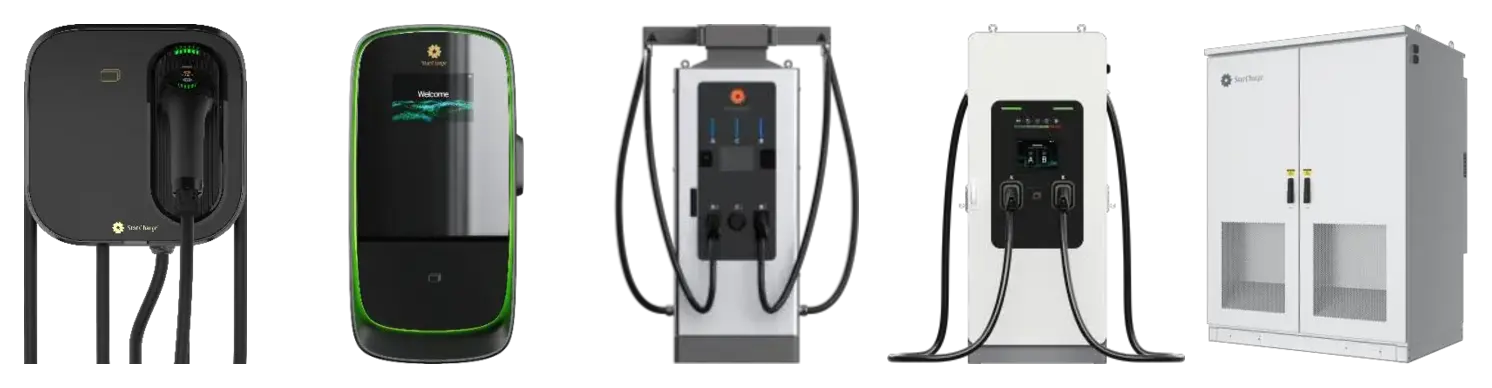
Single-phase or three-phase Type 2 tethered charging with a 5 m cable, RS485 connectivity and RFID or free-charging access options.
IP65 · IK10 · wall or optional pole mounting

 StarCharge
Charger selection comes after vehicle numbers, dwell time, daily energy requirement, available electrical capacity, access rules and future growth have been considered.
Three Type 2 AC product families cover residential, workplace and destination charging. Communications, authentication and load-management functions vary by model and option.
Single-phase or three-phase Type 2 tethered charging with a 5 m cable, RS485 connectivity and RFID or free-charging access options.
Single-phase or three-phase Type 2 tethered charging with 4G, Wi‑Fi, Ethernet, RS485 and Bluetooth 5.0 listed. Authentication options include RFID, app and free charging.

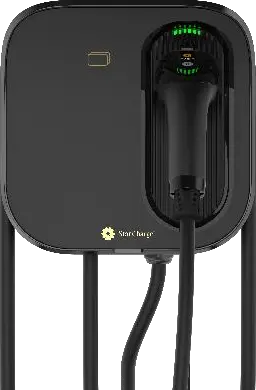
Three-phase AC charging with Type 2 connector or socket options, plus OCPP, Wi‑Fi, Ethernet, Bluetooth, 4G and multiple authentication methods.
| Model | Electrical output | Vehicle connection | Communications & access | Enclosure / mounting |
|---|---|---|---|---|
| Artemis Basic | 7.4 kW / 32 A max single-phase; 22 kW / 32 A max three-phase | 1 × Type 2 plug, Case C; 5 m cable | RS485; RFID or free charging | IP65, IK10; wall or optional pole |
| Artemis Smart | 7.4 kW / 32 A max single-phase; 22 kW / 32 A max three-phase | 1 × Type 2 plug, Case C; 5 m cable | 4G, Wi‑Fi, Ethernet, RS485, Bluetooth 5.0; OCPP 1.6J / 2.0; RFID, app or free charging | IP65, IK10; wall or optional pole |
| Arc Pro | 22 kW / 32 A max three-phase | 1 × Type 2 connector or socket; Case C or B | Wi‑Fi, Ethernet, Bluetooth, 4G; OCPP 1.6J, with 2.0.1 upgrade stated; RFID, app or QR authentication | IP55, IK10; wall or optional pole |
The appropriate DC architecture depends on the number of vehicles, energy per session, turnaround, simultaneous demand, available capacity and the wider site electrical design.
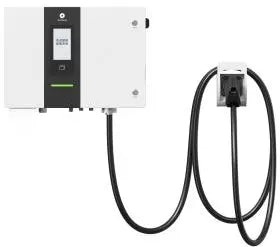
Compact CCS2 charging across a 150–1,000 V DC output range, with a 7-inch touchscreen, RFID or app access and network communications.
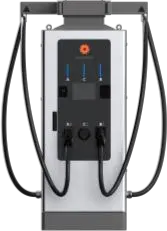
A ground-mounted multi-connector platform with two CCS2 connections and an available configuration that also includes a Type 2 socket.
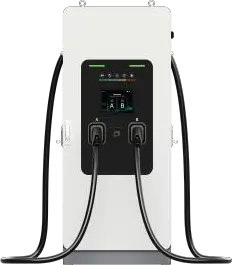
Two-connector CCS2 platform with a 150–1,000 V DC output range, network communications and a 10.4-inch touchscreen.
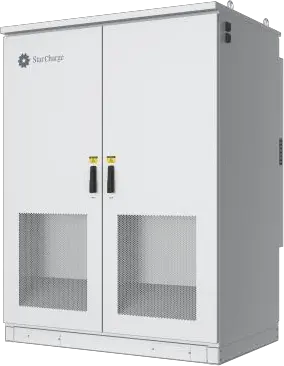
Central power-cabinet architecture designed to distribute output across multiple connected dispensers.
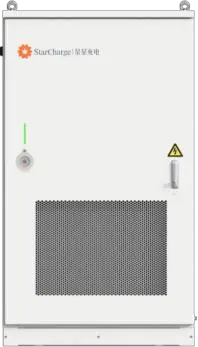
Central power-cabinet architecture for sites that need scalable power distribution across multiple dispensers.
| Model | Rated / maximum output | Connection configuration | Selected functions | Enclosure / mounting |
|---|---|---|---|---|
| Venus V3 | Up to 30 kW; 150–1,000 V DC; 80 A at 20 kW and 100 A at 30 kW | 1 × CCS2 | 7-inch touchscreen; RFID/app; 4G, Wi‑Fi, Ethernet; OCPP 1.6J; emergency button | IP55, IK10; screen IK08; wall or optional pole; indoor/outdoor stated |
| Jupiter V3 | 60 kW DC max plus 22 kW AC max; 150–1,000 V DC; 200 A max per CCS2; Type 2 at 32 A max | 2 × CCS2 + Type 2 socket, or 2 × CCS2 | Simultaneous charging stated; 7-inch touchscreen; RFID/app; 4G, Wi‑Fi, Ethernet; OCPP 1.6J | IP55, IK10; ground mounted; indoor/outdoor stated |
| Titan V5 | 120, 180 or 240 kW; 150–1,000 V DC; 300 A rated per CCS2 connector | 2 × CCS2 | 10.4-inch touchscreen; RFID; optional app; 4G, Wi‑Fi, Ethernet; OCPP 1.6J / 2.0.1 | IP55, IK10; screen IK08; ground mounted |
| Satellite Nova V4 | 480 or 720 kW; 150–1,000 V DC; 1,600 A or 2,400 A | Up to 12 dispenser outputs; vehicle-side connector selected with the dispenser | Power-pool technology; 4G, Wi‑Fi, Ethernet; OCPP 1.6J; emergency stop | IP55, IK10; ground mounted |
| Satellite Nova V5 | 480 kW; 150–1,000 V DC; 1,600 A max | Up to 12 dispenser outputs; vehicle-side connector selected with the dispenser | Power-pool technology; 4G, Wi‑Fi, Ethernet; OCPP 1.6J / 2.0.1; emergency stop | IP55, IK10; ground mounted |
Product views support early placement and user-flow discussions. Final configuration, cable management, mounting and civil scope are resolved in the site design.
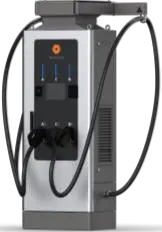
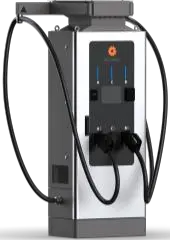

The charger must sit within a safe, usable and expandable site plan.
Vehicle type, connector, battery size, arrival state and daily energy requirement.
Arrival and departure windows, utilisation, queuing and turnaround expectations.
Supply, switchboard, demand profile, diversity and load-management options.
Access, authentication, payments, reporting, cable handling and user flow.
Future vehicle numbers, staging, civil pathways and space for expansion.
Charging can change the site's load profile and may interact with solar, storage and controls.
We can then assess which charging architecture and staged site plan warrant detailed design.